FORMULATION ARTICLES
-
 Protecting The Platform: Trade Secret Protection For RNA Biotech Companies
As RNA therapeutics grow more complex and collaborative, trade secrets are becoming an increasingly important part of protecting valuable platform innovation.
-
 How Should We Measure The True Potency Of RNA Therapeutics?
An RNA therapeutic can generate a strong molecular signal without producing the intended biological function. Let's look at how best to predict whether the RNA has completed its task.
-
 From Albumin To Oncology: Can Chemical Engineering Unlock Solid Tumor Delivery?
We discuss how selective albumin binding improved tumor delivery in preclinical studies and what these findings could mean for the future of siRNA-based cancer therapies.
-
 Beyond GalNAc: Reengineering siRNA For Extrahepatic Delivery
We discuss why effective extrahepatic delivery remains one of the field's biggest obstacles and how chemical engineering may provide a new path forward.
-
 Engineering CAR T Cells With mRNA-LNPs: Applying Oncology Learnings To Allergic Diseases
Targeted lipid nanoparticles (LNPs) could deliver mRNA encoding a CAR directly to T cells inside a patient with allergic disease. The potential implications extend beyond a single allergic condition.
-
 Why Delivery Is Defining The Next Era Of Neuromuscular Therapeutics
Emerging therapies are being designed to safely deliver oligonucleotides to disease-relevant tissues. Delivery is no longer a technical hurdle to overcome but a strategic lever.






FORMULATION VIDEOS
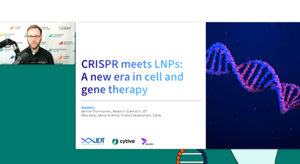
Explore how lipid nanoparticles are revolutionizing non-viral gene editing with scalable, efficient delivery for both ex vivo and in vivo applications, which features new CRISPR-LNP data in T cells.

Single-pass tangential flow filtration effectively concentrates mRNA-LNPs and removes ethanol while maintaining quality. See how this approach produced LNPs with 4.2-fold higher in vitro potency.

Unlike conventional predictive biomarkers, which often focus on isolated molecular markers, this strategy integrates spatial metabolomics and genomics, providing a multidimensional perspective.

CRISPR gene editing and lipid nanoparticle delivery are revolutionizing precision medicine. Discover how optimized LNP systems and advanced analytics accelerate therapeutic development.
ARTICLES, APP NOTES, CASE STUDIES, & WHITE PAPERS
-

Breakthrough therapies are challenged by complex, batch-based manufacturing. A novel, integrated system enables continuous processing, improving consistency and reducing manual handling for advanced modalities.
-

Moving mRNA-LNP production from lab to GMP scale exposes tensions among formulation consistency, regulatory expectations, and facility safety, while automation offers ways to resolve them.
-

Personalized cancer vaccines are advancing quickly, but effective delivery remains a major hurdle. Learn how mRNA and lipid nanoparticle design influence targeting, endosomal escape, and repeat dosing.
-

Prioritize operational efficiency over early-stage flexibility to scale advanced therapies. Standardized workflows and qualified shipping lanes reduce variability for predictable late-phase success.
-

Encapsulated mRNA–LNP creation begins with synthesizing the DNA template. Explore insights on DNA template synthesis, the challenges and strategies of generating a DNA template using PCR, and more.
-

Compared to traditional protein-based therapies, mRNA drugs exhibit unique pharmacokinetic profiles and can be rapidly developed, making overcoming their challenges critical for the industry.
-

Non-PEG stabilizer lipids may offer a new path for LNP design. Combining strong colloidal performance with greater chemical flexibility helps address growing concerns around PEG-related immunogenicity.