
Synergizing HanmiCap® And Prima RNApols For mRNA Potency And Safety
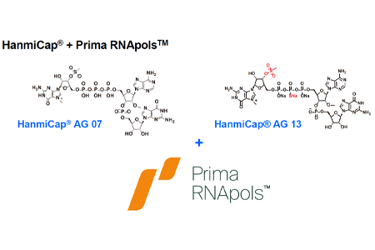
Producing high-quality mRNA for vaccines and therapeutics depends on getting several variables right simultaneously: capping efficiency, yield, purity, and dsRNA levels. When any one of these falls short, downstream performance suffers and immunogenicity risk increases. The question facing many development teams is whether the industry-standard T7 RNA polymerase and conventional cap chemistries are truly the ceiling, or simply the baseline.
Data from a structured screening of 18 RNA polymerases across multiple DNA template lengths and IVT conditions suggest there is meaningful room for improvement. The top-performing polymerases achieved capping efficiencies above 90% on both 2kb and 5kb templates, with dsRNA reductions of up to 13-fold on 2kb templates and up to 20-fold on 5kb templates compared to T7. In one condition, dsRNA fell below the limit of quantification entirely. Purity gains were also notable: one polymerase-cap combination achieved greater than 90% main peak purity on 2kb mRNA, versus below 80% under identical conditions with T7, a difference attributable to reduced abortive transcription.
Yields were comparable or improved, approaching the theoretical maximum in several conditions. Capping efficiency held at 95% across evaluated cap chemistries, indicating compatibility rather than trade-off.
If you are evaluating IVT components for next-generation mRNA programs, access the full poster to review the complete screening dataset, polymerase comparison charts, and KPI assessment methodology.
Get unlimited access to:




Enter your credentials below to log in. Not yet a member of Advancing RNA? Subscribe today.