
RNA Oligonucleotide Synthesis: How Advanced Manufacturing Technologies Are Accelerating Innovation
By Raksha Sharma, DataIntelo

RNA therapeutics are transforming oligonucleotide manufacturing from a chemistry-focused operation into a high-precision technology platform. Each sequence requires controlled synthesis cycles, accurate reagent delivery, reaction monitoring, purification, and analytical verification. As therapeutic designs incorporate longer sequences, chemical modifications, and conjugates, manufacturers increasingly rely on automation, precision fluidics, sensors, and digital process control.
The business challenge is equally significant. According to DataIntelo, the global RNA oligonucleotide synthesis market1 reached $3.23 billion in 2025 and is projected to reach $9.85 billion by 2034, representing a 13.2% CAGR from 2026 to 2034. This expansion is increasing demand for scalable manufacturing systems that improve purified output, reduce material and solvent consumption, and maintain consistent batch performance.
From a technology perspective, the manufacturing objective is shifting toward integrated process optimization. Automated reaction control, low-dead-volume fluidics, real-time monitoring, high-efficiency purification, multivariate analytics, and digitally managed workflows can connect molecular quality with operational performance. FDA guidance recognizes oligonucleotide therapeutics as a diverse modality, reinforcing the need for manufacturing strategies capable of controlling product-specific complexity.
Coupling Efficiency Creates A Mathematical Constraint
Solid-phase phosphoramidite synthesis remains a core approach for short RNA oligonucleotides. Automated synthesizers repeat controlled steps including detritylation, activation, coupling, capping, and oxidation or sulfurization. RNA chemistry adds another layer because the ribose 2′-hydroxyl requires protection during chain assembly. NIH literature describes phosphoramidite synthesis as enabling site-specific modified nucleosides and emphasizes protecting groups, supports, activation, and reaction conditions.
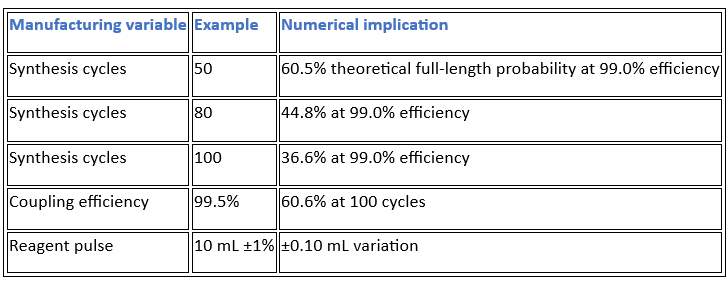
The mathematics of repeated coupling explains why small process improvements matter. If a hypothetical 50-cycle synthesis achieved 99.0% coupling efficiency at every cycle, the theoretical probability of retaining a fully coupled chain would be 0.99^50, or about 60.5%. At 80 cycles, it would decline to 44.8%; at 100 cycles, 36.6%. At 99.5% coupling efficiency, the values become 77.8%, 67.0%, and 60.6% at 50, 80, and 100 cycles, respectively.
These are not manufacturing yields. They exclude side reactions, purification losses, degradation, sequence-dependent effects, and analytical rejection. Their value is engineering: small improvements can reduce the theoretical impurity burden.
Precision Fluidics Converts Equipment Into A Control System
At production scale, reagent delivery becomes an integrated control problem. Flow, pressure, dead volume, valve timing, temperature, mixing, and concentration interact.
Consider a 10 mL reagent pulse controlled to ±1%. The allowed deviation is ±0.10 mL per pulse. Across 100 pulses, the nominal recipe calls for 1,000 mL, while the arithmetic envelope from individual pulse tolerances spans approximately 990 to 1,010 mL. This demonstrates why calibration and monitoring matter.
Residence time provides another example. A reaction zone with 20 mL effective volume receiving liquid at 10 mL/min has a nominal residence time of 2 minutes. At 20 mL/min, residence time falls to 1 minute. A process that changes flow without validating reaction kinetics can therefore alter conversion even when reagent concentration remains unchanged.
Modern platforms use low-dead-volume tubing, calibrated pumps, automated valves, pressure sensors, temperature probes, and recipe-controlled software. These components turn a synthesizer into a measurable control platform.
Reactor Geometry And Support Design Govern Scale-Up
Solid supports influence loading, mass transfer, and reaction performance. Particle size, pore structure, swelling, mechanical stability, and site accessibility all matter.
Column geometry also changes scale-up requirements. A laboratory column with a 1 cm diameter has a cross-sectional area of approximately 0.79 cm². A 5 cm diameter production column has about 19.63 cm², or 25 times the area. Maintaining the same linear velocity would therefore require approximately 25 times the volumetric flow.
This relationship matters during scale-up. Simply multiplying dimensions can change pressure drop, residence time, distribution, mixing, and loading. Scale-up should preserve the physical variables controlling performance.

Purification Determines Usable Output
Synthesis output is not purified product. Crude RNA can contain full-length sequences, truncated chains, modified impurities, residual reagents, salts, and degradation products. Purification therefore determines effective capacity.
Manufacturers should evaluate crude yield, purified recovery, purity, resin utilization, buffer consumption, cycle time, loading, and equipment occupancy together. A process recovering 75% in one cycle may deliver more usable material per equipment hour than a 90% recovery process requiring two additional cycles.
Chromatographic separation can be combined with membrane-based concentration and buffer exchange. NIH literature describes chromatographic purification in RNA oligonucleotide workflows. Recovery depends on membrane retention, concentration polarization, viscosity, fouling, flux stability, and product interactions.
Digital Manufacturing Makes Process Data Actionable
RNA production generates thousands of observations. Flow, pressure, temperature, reagent identity, valve states, reaction times, alarms, and interventions can be captured electronically. The opportunity is correlation.
Suppose a batch records 12 process variables and a final purity result. Reviewing each variable independently may miss an interaction between flow rate, temperature, and reaction time. Multivariate statistical process monitoring can identify relationships among variables and establish normal operating envelopes.
A manufacturer could track pressure excursions per batch, flow deviation in milliliters, temperature variation in degrees Celsius, and chromatography recovery. Over 100 batches, these measurements can reveal whether a recurring equipment signal precedes an impurity increase. That creates an early-warning mechanism.
Quality-by-Design Moves Control Upstream
Quality-by-design connects critical quality attributes with material attributes and process parameters. For RNA oligonucleotides, relevant attributes can include identity, assay, purity, sequence-related impurities, chemical modifications, residual materials, water content, and product-specific structural characteristics.
The objective is to control variation before testing. If an upstream intervention reduces a recurring impurity from 2.0% to 1.0%, the impurity burden has been cut by 50% before purification. Actual downstream benefit depends on impurity chemistry, but upstream control can be more efficient than repeated purification compensation.
The FDA’s 2021 draft guidance for individualized antisense oligonucleotide products provides CMC recommendations for products targeting unique genetic variants, where typically only one or two individuals may be prospectively identified. The guidance highlights the need for appropriate chemistry, manufacturing, and controls information in individualized development programs.
The FDA’s 2024 guidance on clinical pharmacology considerations for oligonucleotide therapeutics also reflects the diversity of this product class and addresses development considerations including immunogenicity, organ impairment, drug interactions, and QTc assessment. Together, these resources reinforce product-specific development and documented manufacturing control.
Continuous And Enzymatic Technologies Expand the Toolkit
Manufacturing innovation increasingly targets solvent use, cycle time, equipment occupancy, and purification burden. Continuous chromatography concepts can improve resin utilization, while membrane systems can intensify concentration and buffer exchange.
Enzymatic RNA synthesis offers another potential pathway. NIH-indexed research describes template-independent enzymatic synthesis as an emerging approach for producing RNA oligonucleotides. Its industrial value should be assessed with comparable metrics: conversion per step, reaction time, enzyme consumption, impurity profile, recovery, solvent requirement, and cost per gram of purified material.
Technology decisions should be based on measurable manufacturing economics. A process that shortens synthesis 20% but raises purification losses 15% may provide less capacity than expected. A modest improvement in coupling, recovery, or cycle duration can compound across a campaign.
A Numerical Road Map For Precision Manufacturing
A practical roadmap begins with measurable targets: higher validated coupling efficiency, tighter pump accuracy, lower pressure variability, shorter chromatography cycles, higher purified recovery, lower buffer consumption, stable membrane flux, fewer deviations, and stronger correlations between process signals and critical quality attributes.
The lesson is multiplicative. If a repeated process step improves from 99.0% to 99.5%, the difference becomes increasingly important as cycle number rises. If purification time falls 10%, the same equipment can support more campaigns without a new train. If buffer consumption falls 20%, material handling and waste loads can decline.
RNA oligonucleotide manufacturing is consequently becoming an integrated technology discipline. Chemistry remains the foundation, but fluidics, support design, reactor geometry, chromatography, membranes, sensors, automation, analytics, and digital control increasingly determine whether molecular designs can be translated into reproducible products consistently at scale.
As sequences become longer, modifications become more sophisticated, and individualized therapies demand flexible production, the strongest manufacturing strategy will be the one that measures every critical step, connects process data to molecular quality, and improves capacity through engineering rather than capacity expansion alone while maintaining quality across the manufacturing campaign.
Reference
About The Author:
Raksha Sharma is a professional writer and researcher at DataIntelo, specializing in emerging technologies, business developments, and data-driven research. She focuses on producing clear, research-based content that helps readers understand complex technical and business topics in a practical and accessible way.