
Nucleic Acid Ligases: Connecting The Pieces For Sustainable And Scalable Production Of Oligonucleotide Therapeutics
By Kevin K. Desai, Ph.D., Founder, Seneca Biotech LLC
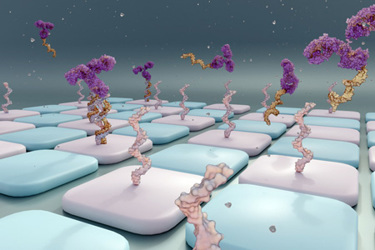
Oligonucleotide therapeutics (ONTs) have emerged as a compelling drug modality with vast potential to treat many diseases. This potential has rapidly led to an increasing number of ONTs receiving FDA approval or entering clinical trials.1–3 The rise of ONTs will place increasing pressure on the capacity to manufacture them at scale. Legacy chemical synthetic methods based on solid-phase phosphoramidite chemistry are limited in their sustainability and scalability.4,5 Fully enzymatic biocatalytic methods for synthesizing ONTs are not yet ready for deployment at scale. Chemoenzymatic ligation is a hybrid chemical and biocatalytic approach that is currently primed to provide a path toward enhanced sustainability and scalability for ONT synthesis.6
The Rise Of Oligonucleotide Therapeutics
Traditional therapeutics treat disease by binding to a disease-related protein to modulate its function. In contrast, ONTs treat disease by binding to a target mRNA through Watson-Crick base pairing and affecting the production of the encoded protein. ONTs are typically about 20 nucleotides in length and contain various chemical modifications that enhance their efficacy (see below). The programmability inherent to ONTs, mediated by base pairing interactions, is an attractive feature since a potential ONT can be predicted based on knowledge of only the target gene sequence.
ONTs have also gained interest due to their capacity to address traditionally undruggable targets and achieve prolonged pharmacological effects. Considerable research and development investment into ONTs has propelled them from rare treatment modalities to therapies for more prevalent disorders.1–3 Indeed, inclisiran is an ONT that lowers cholesterol and is used to treat atherosclerotic cardiovascular disease, which affects millions of people in the United States and is the leading cause of death globally.7,8
The treatment of large patient populations will require multi-ton quantities of ONTs. Moreover, over a dozen ONTs have been FDA approved, with many more under development.9 Therefore, ONT manufacturing capabilities need to be able to satisfy the increasing clinical demand.
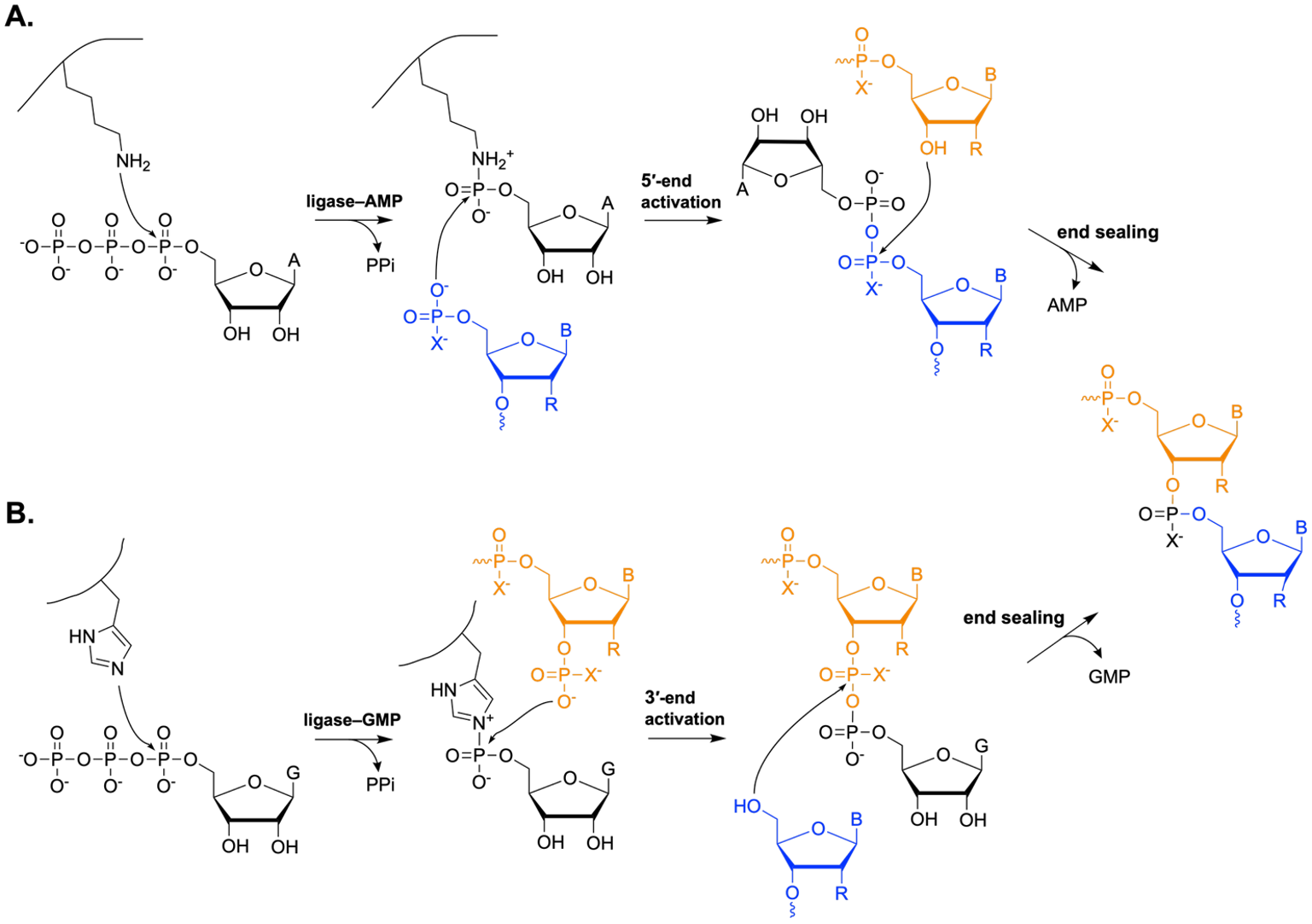
Figure 1. Molecular details of the ligation reaction. (A) The ligation reaction catalyzed by classical ATP-dependent nucleic acid ligases. (B) The ligation reaction catalyzed by the GTP-dependent ligase RtcB. The 3′ nucleic acid strand is orange and the 5′ strand is blue. The phosphorus atom and the two nonbridging atoms at the ligation junction will originate from different strands depending on whether the reaction is catalyzed by classical ligases or RtcB. (R = 2′-H, 2′-OH, 2′-O-methyl, 2′-O-methoxyethyl; X = O,S; A = adenine; G = guanine; B = nucleobase)
Traditional Solid-Phase Oligonucleotide Synthesis Has Limits
Traditional oligonucleotide synthesis uses phosphoramidite chemistry to extend nucleotide sequences that are immobilized on a solid support within a column. This solid-phase oligonucleotide synthesis (SPOS) involves a cycle of iterative deprotection, coupling, capping, and oxidation or sulfurization steps for each nucleotide in the oligo.10,11
SPOS is typically limited to about 10 kg batches because increasing column size results in nonlinear flow rates that decrease product purity. In addition, large excesses of phosphoramidite building blocks are necessary to ensure high coupling efficiencies, and extensive wash steps with solvents are necessary to remove excess reagents and impurities after each reaction step. Moreover, the atom economy for the starting materials is very poor due to the extensive use of protecting groups, which are not incorporated into the final product but are instead discarded as waste.5 After synthesis, the full-length oligonucleotide product is contaminated with impurities. The level of impurities is proportional to the nucleotide chain length because of the increasing number of synthesis steps required for longer sequences. Thus, solvent-intensive chromatographic purification of oligonucleotide products is necessary to remove impurities.12
Remarkably, the use of excess reagents as well as the large quantities of solvents required for washing and purification steps results in thousands of kilograms of waste per kilogram of ONT produced.5 Thus, there is a tremendous need for novel ONT synthesis approaches that address the sustainability and scalability limitations of current methods.
Chemoenzymatic Ligation Offers A Pathway Toward Enhanced Sustainability And Scalability
Chemoenzymatic ligation is an approach for synthesizing ONTs that bridges chemical and enzymatic synthesis. This hybrid approach combines the strengths of chemical synthesis (e.g., proven capability, versatility) with the strengths of enzymatic synthesis (e.g., specificity, mild reaction conditions).
In chemoenzymatic ligation, short oligonucleotides are first chemically synthesized and then enzymatically joined together to generate the full-length oligonucleotide. The sustainability of chemoenzymatic ligation is enhanced because the chemical production of short oligonucleotides is more efficient and higher yielding than production of longer oligonucleotides, which reduces reagent consumption and solvent waste. Scalability is enhanced because, unlike SPOS, the ligation reaction is a solution-based process that is well suited for large-scale batch reactors.4,6
Ligation Proceeds Via A Three-Step Mechanism
Chemoenzymatic ligation uses nucleic acid ligases, which join DNA or RNA strands by forming a phosphodiester bond. In nature, nucleic acid ligases play essential roles in DNA replication and repair, the antiphage response, tRNA splicing, and the unfolded protein response.13–17
In the lab, nucleic acid ligases have been adapted to play critical roles in many molecular biology techniques for modern biotechnology applications. Classical DNA and RNA ligases join 5′-phosphate (5′-p) and 3′-hydroxyl (3′-OH) termini while using Mg(II) and ATP as cofactors (bacterial DNA ligases use NAD rather than ATP). The ligation reaction of classical ligases proceeds through three nucleotidyl transfer steps: (1) reaction of an active site lysine with ATP to form a covalent lysine–AMP intermediate; (2) transfer of AMP to the nucleic acid 5′-p; and (3) attack of the activated 5′-p by the 3′-OH from the opposite strand to form a phosphodiester bond (Fig. 1A).13
The RNA ligase RtcB is an atypical ligase that joins 5′-OH and either 3′-p or 2′,3′-cyclic phosphate termini in a GTP- and Mn(II)-dependent reaction. The ligation reaction catalyzed by RtcB also proceeds through three nucleotidyl transfer steps, with 2′,3′-cyclic phosphate termini being hydrolyzed in a step that precedes 3′-p activation with GMP. The three nucleotidyl transfer steps of RtcB catalysis are: (1) reaction of an active site histidine with GTP to form a covalent histidine–GMP intermediate; (2) transfer of GMP to the nucleic acid 3′-p; and (3) attack of the activated 3′-p by the 5′-OH from the opposite strand to form a phosphodiester bond (Fig. 1B).18–20 Thus, ligases use the chemical energy stored in a phosphoanhydride bond of a nucleoside triphosphate to drive the energetics of the ligation reaction forward.
Substrate Specificities Of RNA And DNA Ligases
The native substrates of nucleic acid ligases provide insights into how to employ them in the lab. The RNA ligases most used for biotechnology applications are T4 RNA ligase 1 (T4Rnl1), T4Rnl2, and RtcB. The native function of T4Rnl1 is to seal the broken tRNA anticodon loop that is cleaved during the antiphage response.21 Thus, T4Rnl1 prefers single-stranded RNA substrates where the ends are colocalized (i.e., a broken stem loop). Additionally, T4Rnl1 can join ssRNA to ssDNA, join ssDNA to ssDNA, and catalyze intramolecular cyclization of ssRNA and ssDNA.22,23
The RNA ligase 2 family includes T4Rnl2 and the RNA-editing ligases.24,25 RNA editing involves the posttranscriptional insertion or deletion of mRNA nucleotides, as programmed by a guide RNA, followed by guide-RNA-templated ligation of the mRNA termini. Thus, T4Rnl2 prefers to seal a nick in a dsRNA duplex, and the bridging template strand can be either DNA or RNA. Remarkably, the RNA specificity requirement of T4Rnl2 originates from a requirement for two ribonucleotides immediately flanking the 3′-OH of the nick; all other nucleotides can be replaced with DNA.26,27 Therefore, T4Rnl2 can ligate the 3′-OH termini of RNA to the 5′-p termini of DNA in a nicked duplex. Importantly, both T4Rnl1 and T4Rnl2 can only ligate 5′-p termini to 3′-OH termini.
The noncanonical RNA ligase RtcB plays a role in tRNA splicing. RtcB ligates the two tRNA exon halves following excision of the intron from the anticodon loop by the tRNA splicing endonuclease.17,28 Thus, RtcB prefers to join single-stranded RNA fragments where the ends are colocalized (i.e., a broken stem loop). In addition, RtcB can ligate ssRNA fragments, a ssRNA 3′-p fragment to a ssDNA 5′-OH fragment, as well as circularize RNA.17–20,29 In contrast to classical ligases, RtcB can only ligate 2′,3′-cyclic phosphate or 3′-p termini to 5′-OH termini.
The DNA ligases most used in biotechnology are T3, T4, T7, Taq, and E. coli DNA ligases. In biology, DNA ligases play critical roles in DNA replication and repair.30 Thus, DNA ligases are adept at joining nicks in dsDNA. The DNA ligases commonly used in biotechnology have similar substrate requirements and will join blunt ends, cohesive termini, and single-stranded nicks in duplex DNA. DNA ligases can also seal a nick in a duplex where one strand flanking the nick is RNA terminating in a 3′-OH.31 DNA ligases have strict end requirements and can only ligate 3′-OH termini to 5′-p termini.

Nucleotide Modifications Commonly Found In ONTs
ONTs have various chemical modifications to enhance their efficacy (Fig. 1).1–3 These modifications must be accommodated by ligases for chemoenzymatic ligation to be successful. One of the first used and most prevalent modifications is a phosphorothioate linkage (PS), which is a phosphate backbone modification where a non-bridging oxygen is replaced with a sulfur.
Another backbone modification commonly found in ONTs is a phosphorodiamidate morpholino (PMO) structure. The PS and PMO modifications confer resistance to nuclease degradation, and PS also increases ONT hydrophobicity, which improves cellular uptake.4 Importantly, PS modifications can result in distinct stereochemical configurations at the phosphorus atom (denoted Rp and Sp), which can affect their activity in vivo.32
The ribose of ONTs is commonly modified at the 2′ position with 2′-fluoro, 2′-O-methyl, or 2′-O-methoxyethyl substituents. These 2′-ribose modifications promote the 3′-endo conformation of the ribose found in native RNA while conferring chemical stability, nuclease resistance, and increased duplex stability with the target mRNA.3,33 The cytosine nucleobase of single-stranded antisense oligos can be modified with a 5-methyl group to improve binding to the target mRNA.34 To achieve targeting to the liver, ONTs can be conjugated to a triantennary N-acetylgalactosamine (GalNAc) moiety at their terminus.3,9
Chemoenzymatic Ligation Has Successfully Synthesized ONTs
Biocatalytic processes are routinely used across the pharmaceutical industry for the synthesis of small molecule drugs.35,36 Biocatalysis is now being harnessed for the synthesis of ONTs as well. While fully enzymatic methods for synthesizing ONTs are under development, a hybrid approach combining chemical and enzymatic steps has emerged as a leading method for producing ONTs at scale.6
Single-stranded antisense ONTs can be produced by chemoenzymatic ligation using a template-dependent approach. In this approach, short chemically synthesized oligonucleotides are annealed to a DNA template strand. The nicks between the short oligonucleotides are subsequently joined using a ligase, and the DNA template is removed by strand separation.4,6 GlaxoSmithKline has used this approach to generate single-stranded antisense oligonucleotide gapmers.37 A related template-dependent approach has also been used to produce the antisense oligonucleotide fomivirsen, which has phosphorothioate linkages between all nucleotides, as well as an LNA gapmer analog of fomivirsen.38 Moreover, a similar templated approach has been used to produce longer sgRNAs for CRISPR gene-editing applications.39
Double-stranded siRNAs can be assembled using RNA fragments with overlapping regions that form base-pairing interactions.4 The overlapping regions function as a self-template for oligonucleotide assembly and eliminate the need for a separate template strand. Novartis has published work describing the chemoenzymatic synthesis of siRNA using T4Rnl2 to join overlapping RNA fragments with 2′-ribose modifications and a 3′-terminal triantennary GalNAc moiety.40 Almac and Alnylam have published a study demonstrating the assembly of short “blockmers” using sequential ligation reactions in a one-pot approach to produce siRNA containing commonly used modifications.41
Another study examined the effects that 2′-ribose modifications at the ligation junction have on the activity of an ancestral T4Rnl2 variant; the ligase was then used to produce patisiran from four overlapping RNA fragments.42 Codexis and Hongene have also reported using chemoenzymatic ligation to produce ONTs.43,44 Collectively, these studies demonstrate that nucleic acid ligases have a remarkable ability to accommodate the 2′-ribose, phosphorothioate, and terminal GalNAc modifications commonly found in ONTs. In addition to improvements in sustainability and scalability, chemoenzymatic ligation also offers higher product purity because ligases require juxtaposed oligonucleotide termini and therefore select against substrates that are not full length.
Looking Ahead
The proof-of-concept phase for chemoenzymatic ligation is rapidly transitioning to the production phase. Alnylam has announced plans to expand its manufacturing facility to accommodate enzymatic ligation for siRNA production.45 The future of biocatalysis for ONT production is bright, and chemoenzymatic ligation offers a pathway to increased sustainability and scalability over legacy SPOS methods.
References
- Crooke ST, Witztum JL, Bennett CF, Baker BF (2018) RNA-targeted therapeutics. Cell Metab 27:714–739.
- Kulkarni JA, et al. (2021) The current landscape of nucleic acid therapeutics. Nat Nanotechnol 16:630–643.
- Egli M, Manoharan M (2023) Chemistry, structure and function of approved oligonucleotide therapeutics. Nucleic Acids Res 51:2529–2573.
- Obexer R, Nassir M, Moody ER, Baran PS, Lovelock SL (2024) Modern approaches to therapeutic oligonucleotide manufacturing. Science 384:eadl4015.
- Andrews BI, et al. (2021) Sustainability challenges and opportunities in oligonucleotide manufacturing. J Org Chem 86:49–61.
- Bizat PN, Sabat N, Hollenstein M (2025) Recent advances in biocatalytic and chemoenzymatic synthesis of oligonucleotides. ChemBioChem 26:e202400987.
- Raal FJ, et al. (2020) Inclisiran for the treatment of heterozygous familial hypercholesterolemia. N Engl J Med 382:1520–1530.
- Palaniappan LP, et al. (2026) 2026 heart disease and stroke statistics: A report of US and global data from the American Heart Association. Circulation 153(9).
- Chen L, Xu J, Li J, Liu G, Ma H (2026) Therapeutic oligonucleotides revisited: Focus on siRNA and antisense technologies. Innovation Drug Discov 1:100007.
- Beaucage SL, Caruthers MH (1981) Deoxynucleoside phosphoramidites—a new class of key intermediates for deoxypolynucleotide synthesis. Tetrahedron Lett 22:1859–1862.
- Gait MJ, Sheppard RC (1978) Solid-phase oligonucleotide synthesis: a renaissance. Nucleic Acids Res 5(Suppl 1):s79–s84.
- Abe A, Časar Z (2025) Overview and recent advances in the purification and isolation of therapeutic oligonucleotides. Org Process Res Dev 29:15–33.
- Shuman S, Lima CD (2004) The polynucleotide ligase and RNA capping enzyme superfamily of covalent nucleotidyltransferases. Curr Opin Struct Biol 14:757–764.
- Abelson J, Trotta CR, Li H (1998) tRNA splicing. J Biol Chem 273:12685–12688.
- Levitz R, et al. (1990) The optional E. coli prr locus encodes a latent form of phage T4-induced anticodon nuclease. EMBO J 9:1383–1389.
- Ron D, Walter P (2007) Signal integration in the endoplasmic reticulum unfolded protein response. Nat Rev Mol Cell Biol 8:519–529.
- Englert M, Sheppard K, Aslanian A, Yates JR III, Söll D (2011) Archaeal 3′-phosphate RNA splicing ligase characterization identifies the missing component in tRNA maturation. Proc Natl Acad Sci USA 108:1290–1295.
- Desai KK, Bingman CA, Phillips GN Jr, Raines RT (2013) Structures of the noncanonical RNA ligase RtcB reveal the mechanism of histidine guanylylation. Biochemistry 52:2518–2525.
- Desai KK, Raines RT (2012) tRNA ligase catalyzes the GTP-dependent ligation of RNA with 3′-phosphate and 5′-hydroxyl termini. Biochemistry 51:1333–1335.
- Chakravarty AK, Subbotin R, Chait BT, Shuman S (2012) RNA ligase RtcB splices 3′-phosphate and 5′-OH ends via covalent RtcB-(histidinyl)-GMP and polynucleotide-(3′)pp(5′)G intermediates. Proc Natl Acad Sci USA 109:6072–6077.
- Amitsur M, Levitz R, Kaufmann G (1987) Bacteriophage T4 anticodon nuclease, polynucleotide kinase and RNA ligase reprocess the host lysine tRNA. EMBO J 6:2499–2503.
- Snopek TJ, Sugino A, Agarwal KL, Cozzarelli NR (1976) Catalysis of DNA joining by bacteriophage T4 RNA ligase. Biochem Biophys Res Commun 68:417–424.
- Sugino A, Snopek TJ, Cozzarelli NR (1977) Bacteriophage T4 RNA ligase: reaction intermediates and interaction of substrates. J Biol Chem 252:1732–1738.
- Ho CK, Shuman S (2002) Bacteriophage T4 RNA ligase 2 (gp24.1) exemplifies a family of RNA ligases found in all phylogenetic domains. Proc Natl Acad Sci USA 99:12709–12714.
- Ho CK, Wang LK, Lima CD, Shuman S (2004) Structure and mechanism of RNA ligase. Structure 12:327–339.
- Nandakumar J, Shuman S (2004) How an RNA ligase discriminates RNA versus DNA damage. Mol Cell 16:211–221.
- Nandakumar J, Ho CK, Lima CD, Shuman S (2004) RNA substrate specificity and structure-guided mutational analysis of bacteriophage T4 RNA ligase 2. J Biol Chem 279:31337–31347.
- Calvin K, Li H (2008) RNA-splicing endonuclease structure and function. Cell Mol Life Sci 65:1176–1185.
- Das U, Chakravarty AK, Remus BS, Shuman S (2013) Rewriting the rules for end joining via enzymatic splicing of DNA 3′-PO4 and 5′-OH ends. Proc Natl Acad Sci USA 110:20437–20442.
- Lehman IR (1974) DNA ligase: structure, mechanism, and function. Science 186:790–797.
- Sriskanda V, Shuman S (1998) Specificity and fidelity of strand joining by Chlorella virus DNA ligase. Nucleic Acids Res 26:3536–3541.
- Iwamoto N, et al. (2017) Control of phosphorothioate stereochemistry substantially increases the efficacy of antisense oligonucleotides. Nat Biotechnol 35:845–851.
- Cummins LL, et al. (1995) Characterization of fully 2′-modified oligoribonucleotide hetero- and homoduplex hybridization and nuclease sensitivity. Nucleic Acids Res 23:2019–2024.
- Lebedev Y, et al. (1996) Oligonucleotides containing 2-aminoadenine and 5-methylcytosine are more effective as primers for PCR amplification than their nonmodified counterparts. Genet Anal 13:15–21.
- Bayer T, Wu S, Snajdrova R, Baldenius K, Bornscheuer UT (2025) An update: enzymatic synthesis for industrial applications. Angew Chem Int Ed 64:e202505976.
- Buller R, et al. (2023) From nature to industry: harnessing enzymes for biocatalysis. Science 382:eadh8615.
- GlaxoSmithKline Intellectual Property Development Ltd (2018) Novel processes for the production of oligonucleotides. World Intellectual Property Organization patent WO2018/011067 A2.
- Sabat N, et al. (2024) Template-dependent DNA ligation for the synthesis of modified oligonucleotides. Nat Commun 15:8009.
- Bigatti M, et al. (2025) Development of a broadly applicable enzymatic ligation process for the production of single guide RNAs. Org Process Res Dev 29:1228–1236.
- Mann G, et al. (2022) Biocatalytic assembly of chemically modified oligonucleotides. Tetrahedron Lett 93:153696.
- Paul S, et al. (2023) Convergent biocatalytic mediated synthesis of siRNA. ACS Chem Biol 18:2183–2187.
- Kajimoto S, et al. (2022) Enzymatic conjugation of modified RNA fragments by ancestral RNA ligase AncT4_2. Appl Environ Microbiol 88:e01679-22.
- Codexis, Inc. (2026) Codexis signs agreement to manufacture 50 g siRNA using its ECO Synthesis® Manufacturing Platform. Press release, 4 March 2026.
- Hongene Biotech (2026) Oligonucleotide manufacturing services. Available at https://www.hongene.com/services/oligo-manufacturing/.
- Alnylam Pharmaceuticals (2025) Alnylam to invest $250 million to add enzymatic ligation platform to U.S. manufacturing facility to meet growing demand. Press release, 17 December 2025.
Competing Interests
The author has no competing interests to disclose.
About The Author
 Kevin K. Desai, Ph.D., is the founder of Seneca Biotech LLC, a provider of consulting services for life sciences research and development. He has six years of experience developing and leading enzyme engineering programs at biotechnology startups. Desai has received National Institutes of Health SBIR grant funding to support enzyme engineering R&D and holds patents on engineered enzymes. During his postdoctoral studies at the University of Wisconsin–Madison, he received an NIH fellowship to study the noncanonical RNA ligase RtcB and its activator protein, Archease. Desai’s consulting specialties are in enzymology, enzyme discovery, enzyme/protein engineering, and RNA/DNA biocatalysis. He can be reached at kevindesai101@gmail.com, or on LinkedIn at www.linkedin.com/in/kevin-desai-774749129.