
Is mRNA Manufacturing Overbuilt?
By Nigel Horscroft, independent biotech consultant

A few years ago, mRNA manufacturing capacity looked like a strategic shortage. COVID-19 vaccines moved from sequence selection to billions of doses at unprecedented speed. Established CDMOs expanded, new specialists entered the market, governments invested in domestic capacity, and manufacturing infrastructure appeared across Europe, North America, Asia, Africa, and Australia.
The picture now looks different. Exothera and AmplifyBio have closed. National Resilience announced plans to wind down six underused sites after acknowledging that its capacity expansion had outpaced industry demand. Other providers have cut costs or found strategic buyers. At the same time, mRNA pipelines continue to advance in oncology, rare disease, protein replacement, gene editing, and infectious disease.
The evidence points to a correction in the market. The important issue is how much of the installed capacity matches current demand. Conventional large-scale capacity may now exceed the needs of the outsourced market, while smaller batches, faster turnaround, frequent construct changes, and individualized therapies create a different set of manufacturing requirements.
Provider Growth Has Outpaced The Pipeline
NICE Insight counted 79 CDMOs with RNA or lipid nanoparticle (LNP) production capability across 148 sites at the end of 2025. Fifty offered in vitro transcription (IVT) mRNA capability. Between 2022 and 2025, the number of IVT mRNA CDMOs increased from 40 to 50, a 25% rise. Over the same period, the preclinical pipeline fell from 217 to 137 assets, while the clinical pipeline grew from 85 to 182. The combined pipeline increased by about 6%, from 302 to 319 assets. Pipeline assets per IVT mRNA CDMO fell from about 7.6 to 6.4.¹
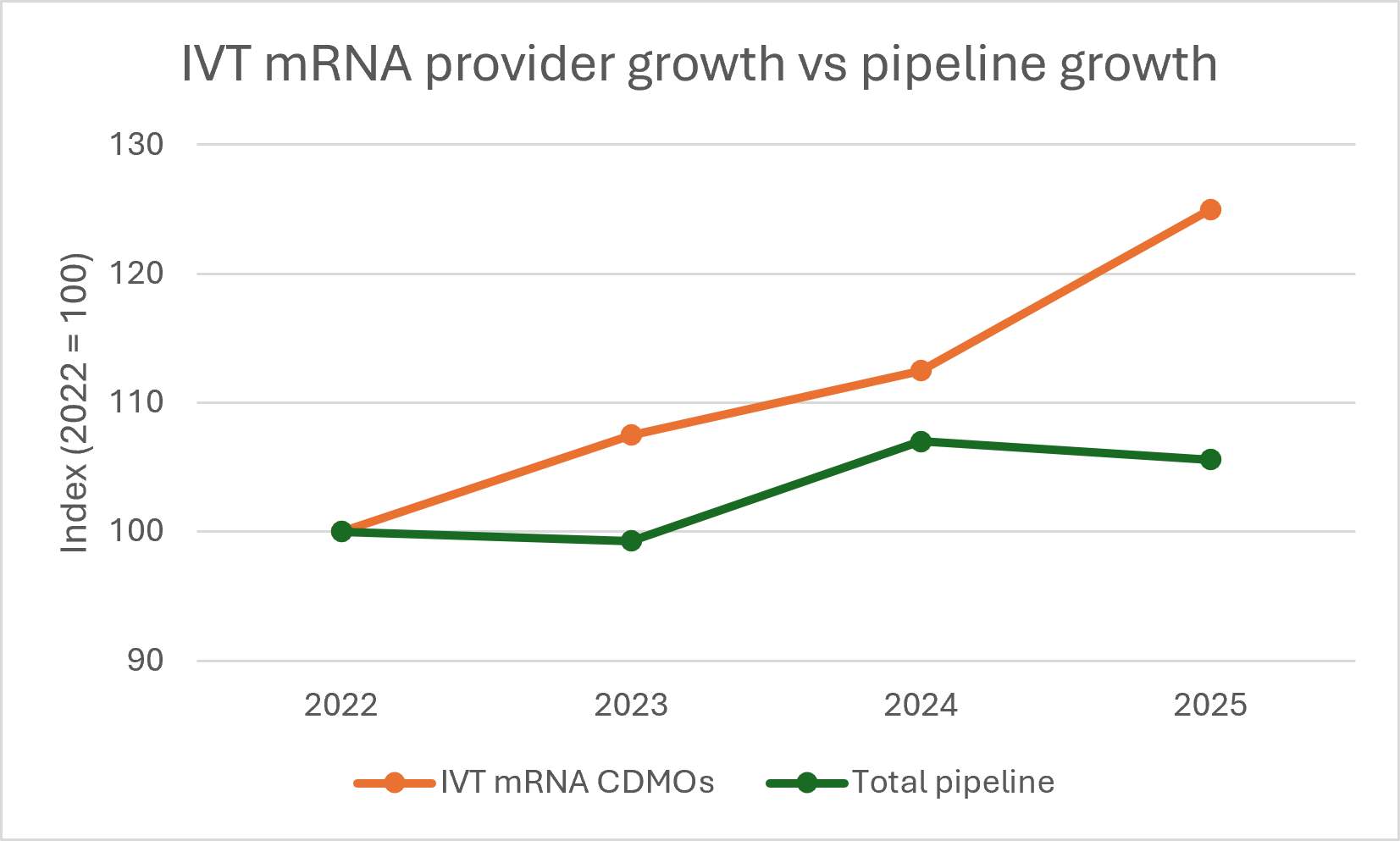
Figure 1A.
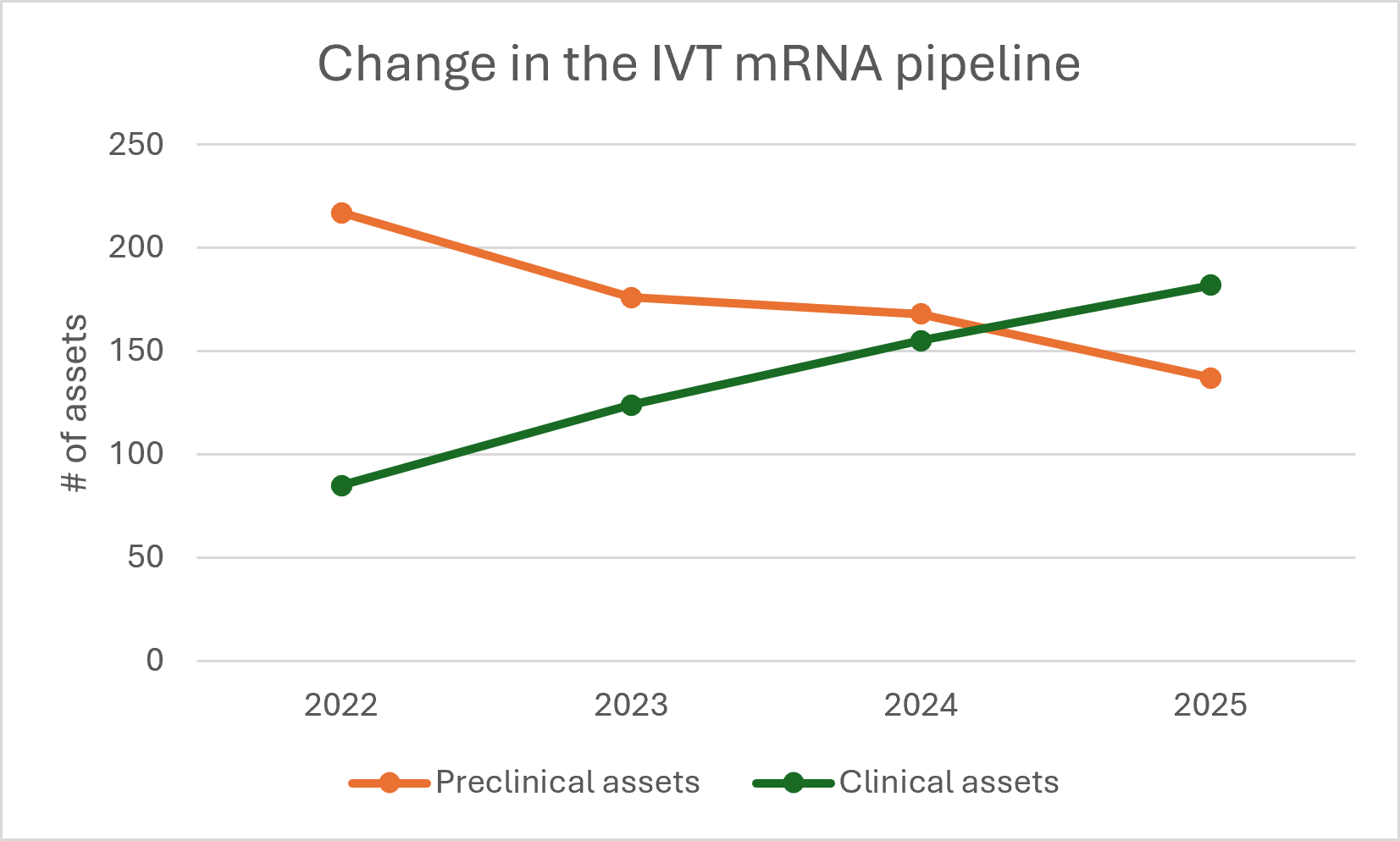
Figure 1B.
Figure 1(A–B): The number of IVT mRNA providers grew faster than the overall pipeline from 2022 to 2025. Panel A compares the IVT mRNA CDMO count with total pipeline growth, indexed to 2022 = 100. Panel B shows the shift from preclinical to clinical-stage programs. Source: NICE Insight & Consulting. Calculations by the author. Pipeline counts are not a direct measure of outsourced manufacturing demand or CDMO utilization.¹
Those figures need some care in interpretation. One late-stage program can generate far more work than dozens of preclinical programs, and many early assets will never require outsourced GMP production. Some will remain in discovery or translational development, and others may rely mainly on contract research organizations. Even with those caveats, provider numbers grew much faster than the overall pipeline.
A separate systematic review identified 244 unique mRNA candidates in active clinical development as of March 1, 2025. Of these, 227 were in early clinical phases and 12 were in late-stage development, with cancer accounting for 102 candidates.² The pipeline is substantial, although much of it remains years away from commercial manufacturing. Several of the largest mRNA developers also have significant internal or dedicated manufacturing capacity, so the number of active programs overstates the addressable outsourced market.
Closures And Acquisitions Are Reshaping The Market
Exothera offered RNA manufacturing as part of a broader advanced therapy and viral vector CDMO business. It was declared bankrupt in 2025, affecting more than 100 employees.³ Its parent, Univercells, was declared bankrupt on October 6, 2025.⁴ Quantoom's RNA manufacturing activities continued under the new legal entity Phoenix Biosciences, while the wider Univercells group disappeared.⁵
AmplifyBio also closed in 2025 after exhausting its investment and acquisition options. The company had added mRNA manufacturing to a broader cell and gene therapy business and linked its difficulties to the poor financing environment for early-stage biotechnology companies.⁶ National Resilience later announced the closure of six underused facilities, with its CEO stating that capacity expansion had outpaced industry demand.⁷ Both cases show how quickly high fixed costs become a problem when project flow weakens.
Other companies have responded by cutting costs or finding strategic buyers. Maravai LifeSciences said in 2025 that its cost structure had been built for a larger business and began measures intended to save more than $50 million annually.⁸ Its TriLink business remained active and subsequently reported year-over-year revenue growth in 2026.⁹ This suggests that established providers with differentiated capabilities can adapt, even after a period of overexpansion.
Acquisitions are creating a different outcome for some technologies. Nutcracker Therapeutics, which developed a highly automated personalized RNA manufacturing platform and offered contract manufacturing services, was acquired by Medici Therapeutics in December 2025, removing it as an independent CDMO option.¹⁰ Valerio Therapeutics signed definitive agreements in August 2026 to acquire Etherna Immunotherapies and plans to invest in and expand Etherna's GMP mRNA and LNP manufacturing capability as part of the combined company, while continuing existing collaborations.¹¹ These transactions suggest that some manufacturing platforms may carry greater strategic value inside therapeutics companies than as stand-alone service businesses.
Taken together, the market is becoming more selective. Business model, customer mix, capital structure, and technical differentiation are starting to matter as much as installed equipment.
mRNA Capacity Means Different Things
The phrase "mRNA manufacturing capacity" covers a wide range of production models. Pandemic vaccines required huge quantities of a relatively small number of products. Many emerging mRNA therapeutics require smaller batches, shorter campaigns, and more frequent product changes. Personalized cancer vaccines add another level of complexity because the amount of mRNA per patient may be small while the number of GMP lots can be very high.
A facility designed around long campaigns and large batch sizes may therefore be poorly matched to the next generation of products. Rare disease, oncology, protein replacement, and gene editing programs may all require different scales and timelines. The manufacturing model has to fit the product rather than simply demonstrate that IVT can be performed.
The buildout has also become global. Australia now has commercial-scale domestic mRNA manufacturing, with Moderna's Melbourne facility capable of producing up to 100 million vaccine doses per year and holding a GMP license since 2025.¹² More distributed systems are also appearing outside the traditional European and North American hubs. Quantoom reports more than 30 installations of its Ntensify RNA production equipment worldwide, including three operating under GMP conditions.¹³ Publicly announced installations include Afrigen Biologics in South Africa,¹⁴ Bio-Manguinhos/Fiocruz in Brazil,¹⁵ and the University of Western Australia's RNA Innovation Foundry in Perth.¹⁶
These installations serve different purposes. The University of Western Australia system supports research and translational work, while the Bio-Manguinhos/Fiocruz site uses a GMP-grade Ntensify midi system. In September 2026, Fiocruz announced that its mRNA platform had received authorization to proceed to clinical testing and that its pilot facility was the first mRNA plant in Latin America with GMP certification.¹⁷ Distributed systems such as these may create regional capacity with a very different cost base and utilization model from a large centralized CDMO facility.
Global capacity is difficult to compare. Wacker describes annual capacity for more than 200 million vaccine doses at its Halle facility.¹⁸ TriLink describes approximately 1 g to more than 100 g per batch.¹⁹ AGC Biologics describes a 10 L platform capable of producing up to 100 g per week.²⁰ Each figure is valid in its own context, but the units reflect different products, operating models, and assumptions.
Commercial economics also vary. Part of Wacker's capacity is supported through a German pandemic readiness agreement under which Wacker and CordenPharma maintain capacity for up to 80 million mRNA vaccine doses annually for the German government.¹⁸ Australia's Moderna facility also arose from a long-term strategic partnership with government.¹² Capacity supported as a national preparedness asset does not face the same utilization pressure as a merchant facility that depends on customer contracts.

The Product Mix Has Changed
The post-COVID expansion was driven partly by expectations of broad growth in mRNA manufacturing demand. The clinical pipeline has continued to develop, but the mix of products has shifted. Many programs now need lower volumes, greater flexibility, and more frequent changes than pandemic vaccine production.
Some programs require rapid turnaround. Others need integrated drug substance and LNP manufacturing, and individualized products may require very short manufacturing and release cycles. These requirements favor smaller economic batch sizes, faster changeover, automation, and flexible scheduling.
Regional and distributed systems may also become more relevant. A platform installed close to local developers or clinical centers can compete on responsiveness and access rather than sheer output. CDMOs that offer only generic IVT capacity will need a stronger reason for customers to choose them.
Ease Of Doing Business Matters More In A Crowded Market
Technical capability, quality, price, and available slots will always drive CDMO selection. Customer experience becomes more important when several suppliers can meet the basic technical requirements. The first interactions often reveal how much effort the relationship is likely to require.
A recent CDMO selection exercise provided a useful example. We almost removed a technically credible provider before issuing the request for proposal because the company's initial confidentiality agreement required disproportionate effort for the limited information we wanted to exchange. The provider later dropped the requirement, and we kept them in the process.
The concern was the approach rather than the existence of legal protections. The interaction felt like a large organization applying its standard position to a smaller company instead of a vendor trying to win a client in a competitive market. A provider that responds quickly, makes proportionate decisions, and gives clear answers can gain an advantage when technical capability is similar across several options.
Commercially, this is important. A capable facility still loses the opportunity if the customer decides the relationship will require too much effort.
What Developers Should Take From The Current Market
Developers should define the manufacturing model they need before comparing providers. Batch size, number of lots, frequency of construct changes, turnaround time, release requirements, and likely commercial scale should all be considered. The right partner for an early clinical study may not be the right partner several years later.
Headline capacity figures also need scrutiny. Installed equipment, qualified suites, available staff, and open manufacturing slots are different things. Maximum batch size is useful only when the provider can deliver the required batch at the required time.
Business resilience belongs in the assessment as well. Recent closures show that technical capability does not guarantee continuity. Ownership, financing, customer concentration, layoffs, site strategy, and changes in ownership can all affect a program that depends on the same supplier for several years.
The working relationship should be judged from the start. Initial technical discussions, the confidentiality agreement, and the RFP process show how the company communicates and makes decisions. Those early signals are worth paying attention to.
Is The Market Overbuilt?
Further closures, acquisitions, and reductions in capacity would not be surprising. IVT mRNA provider numbers have grown faster than the overall pipeline, and early-stage biotechnology funding remains difficult. Large facilities with high fixed costs will struggle if expected projects do not appear.
The clinical pipeline is still growing and maturing. Manufacturing demand is becoming more diverse, with increasing need for smaller batches, faster turnaround, distributed systems, and integrated end-to-end solutions. Some parts of the market may therefore remain oversupplied while others continue to lack suitable capacity.
For developers, sheer output is becoming a less useful measure of capability. The more relevant questions are whether a provider can make the required amount, on the required schedule, at a workable cost, and whether the organization is likely to remain a reliable partner as the program advances.
References
- Smith DC. Inside the Advanced Therapies CDMO Landscape: Factors Shaping Advanced Therapies Manufacturing. NICE Insight & Consulting. Presented at Advanced Therapies Week 2026.
- Moschioni M, Siraji RA, Dissard R, et al. "mRNA vaccines and therapeutics beyond COVID-19: A review of the global clinical development landscape, low- and middle-income countries involvement and relevance to their contexts." Human Vaccines & Immunotherapeutics. 2026;22(1):2628424. doi:10.1080/21645515.2026.2628424.
- Parlement de Wallonie. "La faillite de la biotech jumétoise Exothera." Written question and response, 2025.
- Parlement de Wallonie. "La faillite d'Univercells à Jumet." Written question and response, 2025.
- Quantoom Biosciences. "About Quantoom Biosciences."
- AmplifyBio. "Important Announcement: AmplifyBio Operations Closure." 2025.
- Wu G. "National Resilience, a well-funded manufacturing startup, to scale back operations." BioPharma Dive. June 10, 2025.
- Maravai LifeSciences Holdings. "Maravai LifeSciences Reports Second Quarter 2025 Financial Results." August 11, 2025.
- Maravai LifeSciences Holdings. "Maravai LifeSciences Reports Second Quarter 2026 Financial Results." August 2026.
- LaHucik K. “ARCH, Parker Institute build next big oncology bet with suite of programs and startup acquisition.” Endpoints News. December 2, 2025.
- Valerio Therapeutics. "Valerio Therapeutics announces signing of definitive agreements for the acquisition of Etherna Immunotherapies..." August 24, 2026.
- State Government of Victoria, Department of Jobs, Skills, Industry and Regions. "Population scale mRNA manufacturing."
- Inside Tx, in partnership with Quantoom Biosciences. "Ntensify mRNA Synthesis System."
- Quantoom Biosciences/Afrigen Biologics. Public announcements concerning installation of the Ntensify midi at Afrigen's Cape Town GMP facility and subsequent technical production of an mRNA Rift Valley fever vaccine candidate.
- Quantoom Biosciences. "Ntensify midi System Adopted by Bio-Manguinhos/Fiocruz Laboratory for Future Groundbreaking mRNA Vaccine Production in Latin America." March 7, 2024.
- Quantoom Biosciences. "University of Western Australia's RNA Innovation Foundry Selects Quantoom Biosciences' Ntensify mini for Advanced RNA Research and Technology." December 3, 2025.
- Fiotec/Fiocruz. "Fiocruz recebe autorização para testes clínicos da primeira vacina RNAm brasileira." September 3, 2026.
- Wacker Chemie AG. "WACKER Opens mRNA Competence Center in Halle an der Saale, Germany." June 3, 2024; and Wacker reporting on the German pandemic preparedness agreement.
- TriLink BioTechnologies. "cGMP mRNA Manufacturing Facility."
- AGC Biologics. "Messenger RNA Development & Manufacturing."
About The Author:
 Nigel Horscroft, D.Phil., has extensive experience in biotechnology and pharmaceutical R&D, spanning mRNA therapeutics, vaccines, oncology, rare disease, and externalized development. He has held CSO, CTO, and other scientific leadership roles at various biotech companies, and previously worked on mRNA therapeutic programs at CureVac and Ethris. Before becoming a scientist, he spent three years working as a journalist, experience that shaped his interest in communicating complex ideas clearly to different audiences. His work now combines scientific and technical leadership with strategic advice across drug discovery, translational development, CMC, and the progression of innovative therapeutics toward the clinic.