
How Polymerase Selection Shapes IVT Outcomes: Insights From An Independent Evaluation
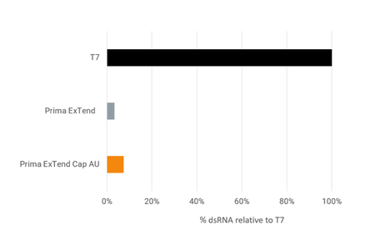
When building an mRNA synthesis workflow, polymerase selection is often treated as a fixed variable. But independent testing by Hongene Biotech reveals it may be one of the most consequential decisions in IVT process development. Evaluating Primrose Bio's engineered RNA polymerases against wild-type T7 across a 9.5 kb template, multiple buffer systems, and varied reaction conditions, the study found that polymerase identity was the dominant driver of dsRNA formation, with engineered variants producing more than 10x lower dsRNA than T7.
Critically, these reductions correlated with measurably higher mRNA integrity, suggesting a mechanistic link between polymerase behavior and transcript quality. Yield and capping performance remained competitive for one of the engineered variants, pointing toward a viable path for improving output purity without sacrificing efficiency. For teams navigating IVT optimization, this data reframes a seemingly routine component choice as a strategic lever. Read the full case study to see how the results break down across conditions.
Get unlimited access to:




Enter your credentials below to log in. Not yet a member of Advancing RNA? Subscribe today.